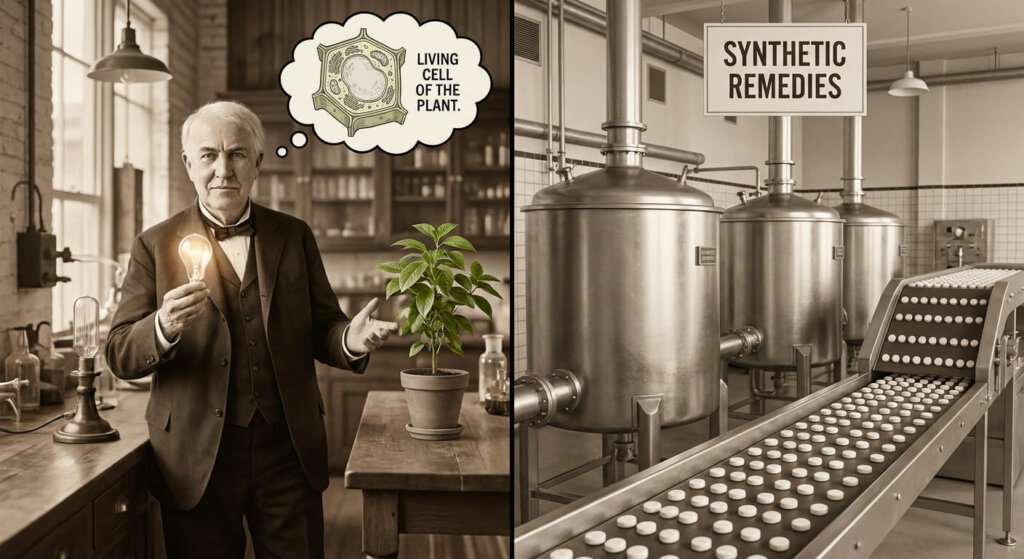
Thomas Edison was the undisputed master of the artificial world. He built the modern industrial age with his own two hands. He illuminated the dark. He recorded sound. Yet, when it came to human health, he issued a stark, highly controversial warning.
“Remedies from chemicals will never stand in favor compared with the products of nature,” Edison wrote. He praised “the living cell of the plant.”
This represents the second half of his famous quote. During an era when massive pharmaceutical companies were just beginning to synthesize miracle drugs in sterile laboratories, Edison actively pushed back. He argued that remedies reduced purely to synthetic, isolated compounds missed something incredibly fundamental. They lacked the holistic intelligence of the natural world.
For decades, mainstream medicine dismissed this view. It was seen as backwards. It was viewed as unscientific folk wisdom. Doctors wanted neat, white pills, not messy green leaves. But the tide is turning. Slowly, but unmistakably, modern science is proving the great inventor right.
This article explores the great medical debate. It dives into the ancient library of plant medicine. It reveals the dangers of synthetic isolation. It shows why nature remains the greatest pharmacist the world has ever known.
Millions of Years of R&D
When Edison spoke of the “living cell of the plant,” he was pointing at something extraordinary. Plants are not passive, decorative scenery. They are biochemical engineers of staggering sophistication. They are chemical warriors.
Over hundreds of millions of years, plants developed a massive arsenal of chemical compounds. Alkaloids. Flavonoids. Terpenes. Polyphenols. Glycosides. Nature did not just create these for fun. Each compound was designed with a highly specific biological function.
Many of these compounds evolved as fierce defense mechanisms. A plant cannot run away from a predator. It must fight with chemistry. It creates compounds to repel insects. It creates compounds to kill fungi. It creates compounds to survive harsh, freezing weather.
Fascinatingly, these exact same defense compounds interact powerfully with the human body. Our bodies evolved alongside these plants. Our cells recognize this chemistry.
Nature did not just stumble onto these formulas. She refined them over geological time. She honed them into absolute precision tools. No pharmaceutical research and development budget in human history can compete with a timeline of 500 million years.
A Story from the Amazon Rainforest
Humanity has known this for millennia. Archaeological evidence strongly suggests humans have used medicinal plants for at least 60,000 years. Ancient Neanderthal graves have been found lined with specific medicinal herbs like yarrow and chamomile.
Consider a modern story from the 1980s. Ethnobotanist Mark Plotkin traveled deep into the Amazon rainforest. He wasn’t looking to mine gold. He wasn’t looking to cut down timber. He was looking for medicine [10]. He found it in breathtaking abundance.
Plotkin lived with indigenous shamans. These healers showed him plants that effectively treated complex fungal infections. They managed severe, debilitating pain. They healed terrible wounds. They induced powerful altered states of consciousness for psychological healing.
All of this was achieved without a single modern, double-blind clinical trial. It was data. It was refined across thousands of years of continuous human observation, trial, and error. One specific plant compound Plotkin documented—curare, traditionally used on poison blow darts—became the basis for a vital muscle relaxant used in modern open-heart surgery today.
Plotkin returned from these jungle trips profoundly changed. He realized the fragility of this ancient knowledge. “When a shaman dies,” he famously remarked, “it’s as if a library burns down” [10].
Edison would have understood this tragedy perfectly. That ancient knowledge is incredibly precious. It is a roadmap to human health.
Chemicals vs. Nature: The Great Medical Debate
Let us be completely fair. Synthetic medicine has saved hundreds of millions of lives. Surgical anesthesia transformed the agonizing world of surgery. Vaccines eradicated horrific diseases like smallpox. Antibiotics have arguably done more to extend human longevity than any other medical intervention in history.
Edison was not saying chemicals are completely useless. He was not an anti-science fanatic. He was saying they are incomplete. They are blunt instruments. And modern research is confirming exactly that.
From Willow Bark to Aspirin
One of the most compelling stories of nature’s pharmacy involves a common tree. For thousands of years, ancient cultures used willow bark to relieve intense pain and reduce high fevers.
The ancient Sumerians left clay tablets detailing its use. The ancient Egyptians knew its power. The Greek physician Hippocrates, revered as the father of medicine, routinely prescribed willow bark tea to women to ease the pain of childbirth [11].
For centuries, people simply chewed the raw bark. Or they brewed it into a bitter, earthy tea. It worked beautifully. It reduced inflammation. It stopped pain.
It wasn’t until the 19th century that scientists decided to isolate the magic. In 1828, a German chemist named Joseph Buchner isolated the specific active compound. He called it salicin [12].
Later, scientists synthesized a more potent chemical version. Finally, a chemist at the massive Bayer company found a way to modify it further. His name was Felix Hoffmann. He created acetylsalicylic acid. Bayer aggressively branded it as Aspirin [12].
It was a triumph of the industrial age. It was incredibly easy to mass-produce in gigantic vats. It was easy to put into a neat, white pill. But there was a massive catch.
Isolated, highly synthesized aspirin can be incredibly harsh on the human stomach. It can cause severe gastric ulcers. It can cause internal bleeding. People die every year from aspirin-induced bleeding.
The original, natural willow bark did not cause these severe issues. Why? Because the natural plant contains built-in buffers. It contains other compounds that protect the stomach lining while delivering the pain relief. The living cell of the plant is perfectly balanced. The synthetic, isolated chemical is a harsh, highly flawed copy.
The Entourage Effect: Nature Refuses to Be Simplified
This willow bark story brings us to a crucial biological concept. Scientists now call it the “entourage effect” [13].
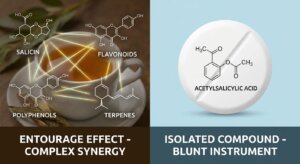
Nature absolutely refuses to be simplified. She builds complexity in intricate layers. When a plant produces a medicinal compound, it never, ever acts alone. It includes hundreds of other compounds. It includes minor cannabinoids. It includes fragrant terpenes. It includes colorful flavonoids.
These extra ingredients work together like a symphony orchestra. They modulate one another. They soften the harsh edges. They significantly amplify the therapeutic benefits. They dramatically reduce the toxic side effects. The whole plant is vastly greater than the sum of its isolated parts.
We see this everywhere in modern research. In the early 2000s, researchers studying cannabis noticed a glaring issue. Isolated, synthetic THC produced extreme anxiety and paranoia in patients. It offered far fewer medical benefits compared to the whole plant extract [13]. It lacked the buffering CBD and relaxing terpenes found in the actual flower.
We see it in turmeric. Turmeric is an ancient Ayurvedic root. The isolated chemical compound is called curcumin. Taken alone, curcumin is incredibly poorly absorbed by the human body. You essentially pee it out. But when combined with piperine, a compound found in plain black pepper, its absorption skyrockets by 2000 percent [14]. Nature demands synergy.
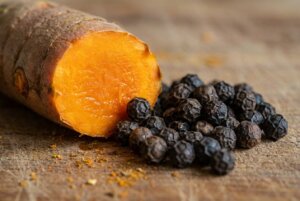
Pharmaceutical science, by its very design, actively seeks to destroy synergy. It seeks to isolate. It wants a single, active molecule. Why? Because you can patent a single molecule. You can monopolize it. You cannot patent a whole plant. But nature keeps whispering to the scientists: That is not how I work.
The Side-Effect Problem
Synthetic drugs carry immense, terrifying side effects. This is exactly why television pharmaceutical advertisements always end with incredibly long, rapid-fire lists of consequences. Dry mouth. Nausea. Severe liver damage. Internal bleeding. Suicidal ideation.
This is not a moral failing of pharmaceutical executives. It is a structural reality of synthetic chemistry. The human body is not a machine with simple on/off switches. It is an intricately balanced, interconnected ecosystem.
A synthetic molecule is engineered to hit one specific biological target. But it will inevitably crash into dozens of others. It forces biological locks open, scratching the mechanism in the process.
The collateral damage is stunning. A 2019 report by the World Health Organization noted a grim statistic. Adverse drug reactions are among the leading causes of death in high-income countries [15]. Legal, prescribed synthetic drugs kill massive amounts of people.
Meanwhile, many plant-based traditional remedies carry safety profiles refined over centuries of continuous human use. Nature has already run the long-term clinical trials. We simply haven’t paid attention.
What Modern Science Is Finally Admitting
The scientific tide is finally turning. Mainstream medicine is no longer comfortable blindly dismissing the wisdom of the living plant. The evidence is simply too overwhelming.
The World Health Organization explicitly acknowledges the central, vital role of plant-based medicine. Their strategy calls for the integration of traditional medicine into modern healthcare systems. Today, over 80 percent of the world’s population still relies on traditional herbal medicine as their primary care [16].
Furthermore, roughly 50 percent of all approved clinical drugs between 1981 and 2019 were derived from, or directly inspired by, natural plant products [17]. Half of our modern medical miracles were invented by a plant first.
We are systematically validating ancient, traditional claims using modern lab equipment.
- St. John’s Wort: This yellow flower has been used for centuries to treat nervous disorders. Rigorous, modern clinical trials now show it can be just as effective as leading prescription antidepressants for treating mild to moderate depression. Crucially, it comes with far fewer side effects [18].
- Ginkgo Biloba: The leaves of this ancient tree have been a staple in traditional Chinese medicine for millennia. Modern research confirms it increases blood flow to the brain. It is heavily studied for its modest benefits in improving cognitive health and delaying the onset of dementia [19].
The Microbiome Revelation
Perhaps the most humbling development in modern medicine is the discovery of the human microbiome. This is a discovery Edison could never have foreseen, but he absolutely would have celebrated it.
Your body is not just yours. Your gut contains roughly 38 trillion microbial cells [20]. These bacteria, fungi, and viruses outnumber your human cells. They are not mere passengers. They are vital, life-giving partners.
They synthesize essential vitamins. They completely regulate your immune system. They heavily influence your mood through the gut-brain axis. Most of your body’s serotonin—the happy chemical—is produced in the gut, not the brain.
And these microbes are exquisitely sensitive to diet. Synthetic pharmaceuticals act like a nuclear bomb in the gut. Broad-spectrum antibiotics devastate this delicate ecosystem. They wipe out the good bacteria with the bad. The collateral damage to human health is immense.
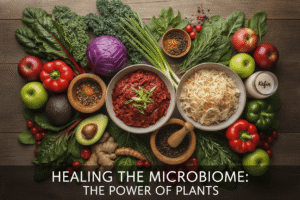
What heals the microbiome? What brings it back to life? The living cell of the plant.
Plant fiber feeds the beneficial bacteria. They ferment it into healing fatty acids. Fermented plant foods like kimchi, sauerkraut, and kefir introduce healthy microbes directly into the system. Nature built a sophisticated pharmacy right inside your stomach. And it runs absolutely best on natural, plant-based inputs.
Bridging the Gap: A Humbler Path Forward
On a deeply personal level, Edison’s wisdom suggests a quietly radical idea. What if we took back some responsibility for our own health? What if we stopped relying entirely on the synthetic lab?
Kitchen gardens were once the standard in every single home. Families grew rosemary, thyme, Echinacea, mint, and sage. They did not grow them merely to make their food taste better. They grew them because they were the family medicine cabinet.

Ginger for intense nausea. Garlic for bacterial infections. Lavender for severe anxiety and sleeplessness. Modern clinical research has validated almost all of these ancient uses. They are not silly folk superstitions. They are ancient observations confirmed by modern tools [21].
Edison’s good friend, the legendary industrialist Henry Ford, reportedly kept one specific idea close to his heart for his entire life. He once said, “The doctor of the future will give no medicine, but will instruct his patient in the care of the human frame, in diet and in the cause and prevention of disease.”
It would be a grave, foolish mistake to read Edison’s quote and conclude that we must reject modern science entirely. The path forward is not rejection. We do not need to burn down the hospitals. The path forward is integration.
We absolutely need the emergency room. We need the modern surgical suite. We need advanced trauma care. But we also desperately need the meadow. We need the untouched rainforest. We need the healthy, organic soil.
The living cell of the plant holds brilliant secrets we are only just beginning to grasp. Nature has been running her clinical experiments far longer than we have. The truly brilliant, curious scientist knows exactly when to stop talking, put down the beaker, and start listening to the earth.
So let nature laugh, by all means. But let us be paying very close attention to what her laughter is trying to tell us. Our very survival may depend on it.
References:
[10] Plotkin, M. J. (1993). Tales of a Shaman’s Apprentice: An Ethnobotanist Searches for New Medicines in the Amazon Rain Forest. Viking. ISBN: 9780670835638.
[11] Twist Bioscience. (n.d.). Aspirin, The 5000 Year-Old Wonder Drug.
[12] The Pharmaceutical Journal. (2014, September 26). A history of aspirin.
[13] Russo, E. B. (2011). “Taming THC: potential cannabis synergy and phytocannabinoid-terpenoid entourage effects.” British Journal of Pharmacology, 163(7), 1344–1364.
[14] Shoba, G., et al. (1998). “Influence of Piperine on the Pharmacokinetics of Curcumin in Animals and Human Volunteers.” Planta Medica, 64(4), 353–356.[15] World Health Organization (2019). Medication Safety in Polypharmacy: Technical Report. WHO/UHC/SDS/2019.11.
[16] World Health Organization (2019). WHO Traditional Medicine Strategy 2019–2025.
[17] Newman, D. J., & Cragg, G. M. (2020). “Natural Products as Sources of New Drugs over the Nearly Four Decades from 01/1981 to 09/2019.” Journal of Natural Products, 83(3), 770–803.
[18] National Center for Complementary and Integrative Health. (2017). St. John’s Wort and Depression: In Depth.
[19] MDPI. (2024, May 27). Ginkgo biloba: A Leaf of Hope in the Fight against Alzheimer’s Dementia: Clinical Trial Systematic Review.
[20] Sender, R., Fuchs, S., & Milo, R. (2016). “Revised Estimates for the Number of Human and Bacteria Cells in the Body.” Cell, 164(3), 337–340.
[21] Ulbricht, C., & Basch, E. (Eds.) (2005). Natural Standard Herb & Supplement Reference: Evidence-Based Clinical Reviews. Mosby.
Previous Post: Until man duplicates a blade of grass- Part 1
